
Hazardous Waste Accumulation and Disposal in Industrial Facilities Managing Chemical Residues, Pharmaceutical Materials, and Radioactive Devices
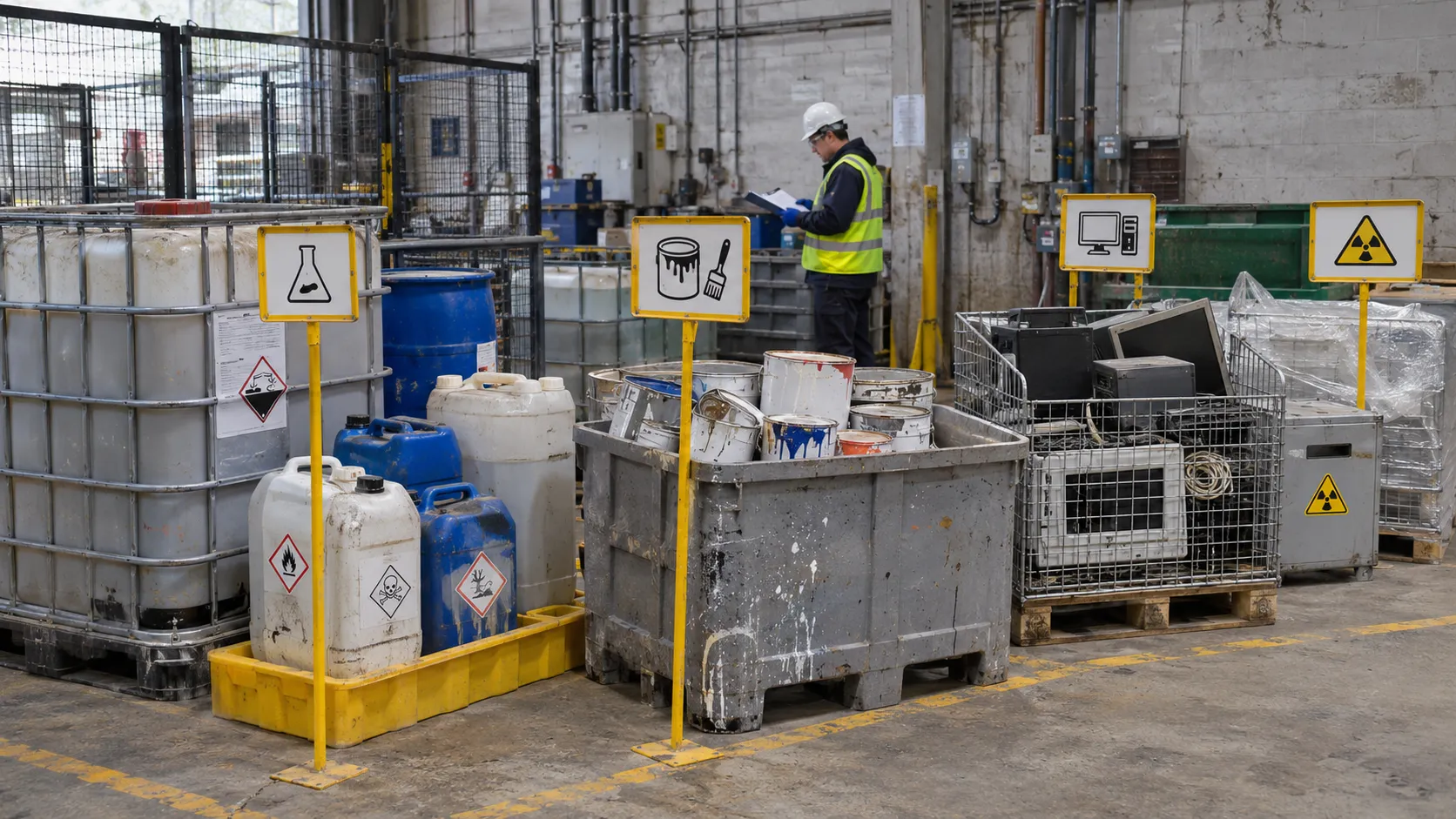
Industrial facilities rarely generate just one type of regulated waste. Routine maintenance, production processes, laboratory operations, and equipment replacement can leave behind materials with different chemical and physical properties. Over time, these items may accumulate in maintenance rooms, chemical storage areas, laboratories, and designated waste collection points.
The challenge is not simply arranging removal. Before accumulated materials can be shipped, generators need to understand what they have, whether the waste streams are compatible, and what documentation is required for each category.
This becomes particularly important when a facility holds flammable paint products, expired pharmaceutical compounds, corrosive liquids, and radioactive devices at the same time. Each material may require a different waste profile, packaging arrangement, and processing facility.
Evaluating Accumulated Waste Before a Disposal Project
An industrial waste inventory should begin with the identification of individual products and process residues rather than a general estimate of the number of containers.
Old storage areas can contain materials that have been sitting unused for years. Original labels may be damaged, product formulations may have changed, and documentation may no longer be readily available.
Reviewing Chemical Identity and Container Information
The first stage involves collecting all available identification details, including:
- Product names and manufacturer information
- Chemical ingredients and concentrations
- Container sizes and approximate remaining quantities
- Physical state and visible condition
- Original purpose and generating process
- Available Safety Data Sheets
- Dates of accumulation, where documented
Generators should not identify unknown chemicals based solely on appearance, odor, or container shape. If the original product information is missing, additional evaluation may be needed before a disposal route can be established.
For industrial operations arranging hazardous waste disposal Chicago, a properly prepared inventory helps determine which materials can be evaluated together and which require separate waste profiles.
Separating Flammable Paint Waste From Other Industrial Chemicals
Paint and coating residues are common in manufacturing facilities, equipment maintenance departments, metalworking operations, and commercial workshops.
However, paint waste is not one uniform material category. Different coating formulations, solvents, and contaminated application materials can have significantly different characteristics.
Managing Partially Used Paints and Industrial Coatings
Waste may include oil-based paints, latex coatings, stains, varnishes, primers, and specialized industrial finishes.
Some products may contain flammable solvents, while others require evaluation based on their chemical composition and potential contaminants. The fact that a coating is water-based does not automatically establish that it can be disposed of as ordinary waste.
ADCO Environmental Services offers Paint Waste Disposal for commercial and industrial generators, including oil-based paint, latex paint, stains, and related materials.
Businesses seeking Paint Waste Disposal Indianapolis should also consider the secondary materials generated during painting and maintenance work.
Solvents, Aerosols, and Contaminated Application Materials
Paint-related operations can produce several additional waste streams:
- Acetone and MEK used for cleaning
- Paint thinners and mineral spirits
- Spray paint and other aerosol cans
- Solvent-soaked brushes and rollers
- Oily or stain-covered rags
- Residues from equipment and surface preparation
These materials should be identified individually before packaging. Aerosol containers, for example, may present different transportation considerations from liquid paint stored in drums or smaller containers.
A waste inventory that separates these materials can help prevent incorrect assumptions about their classification and shipping requirements.
Pharmaceutical Waste From Industrial and Research Operations
Pharmaceutical materials may be generated by pharmaceutical manufacturers, research laboratories, healthcare-related institutions, and other organizations handling chemical compounds.
Expired products are not necessarily identical from a waste management perspective. Their composition, concentration, formulation, and potential hazardous characteristics all influence how they should be evaluated.
Identifying Pharmaceutical Compounds and Expired Products
A pharmaceutical inventory should include the original product name, active ingredient, concentration, quantity, and available manufacturer documentation.
ADCO lists several pharmaceutical compounds among the waste types it accepts for evaluation, including:
- Arsenic trioxide
- Cyclophosphamide
- Epinephrine
- Warfarin
These compounds should not be treated as interchangeable simply because they fall under the broad pharmaceutical category.
For organizations seeking Pharmaceutical Waste Disposal Jacksonville, providing accurate product information is particularly important when materials have been stored for extended periods or are no longer in their original packaging.
Pharmaceutical Materials Mixed With Laboratory Chemicals
Research and production facilities may also encounter pharmaceutical compounds mixed with solvents, reagents, or other laboratory materials.
The resulting mixture may have characteristics that differ from the original pharmaceutical product. Consequently, the inventory should distinguish between unused commercial products, laboratory residues, and mixtures generated during research or production activities.
ADCO offers lab packing and waste management support for hazardous and non-hazardous laboratory materials. The appropriate arrangement depends on the actual contents and compatibility of the materials being submitted.
Radioactive Smoke Detectors and Fire Alarm Components During Facility Upgrades
Radioactive devices can remain installed in industrial buildings long after their original maintenance records have been misplaced.
This is particularly relevant during fire protection system upgrades, large-scale renovations, and demolition preparation.
Recognizing Radioactive Materials in Smoke Detection Equipment
Certain ionization smoke detectors contain Americium-241 or Radium-226. These radioisotopes are incorporated into the detector’s internal assembly and require an appropriate disposal route when the device reaches the end of its service life.
Some self-luminous fire pull switches also contain Tritium (H-3), which is different from the radioactive sources found in conventional ionization smoke detectors.
Facilities should therefore distinguish between radioactive detector models, self-luminous fire pull switches, and ordinary electronic fire alarm components.
ADCO provides a specialized Radioactive Smoke Detector Disposal service through its relationship with licensed radioactive waste processing facilities.
For commercial properties arranging Smoke Detector & Fire Alarm Disposal Los Angeles, documenting the device type and available manufacturer information can help establish which units belong in the radioactive waste inventory.
Maintaining Records After Radioactive Device Removal
Radioactive smoke detector disposal should include appropriate documentation of the final processing.
ADCO’s program provides documentation after the accepted smoke detectors have undergone final destruction at the partnered processing facility. Generators can retain these records as evidence of the completed disposal process.
This is particularly useful for organizations maintaining environmental compliance files across multiple buildings or departments.
Managing Different Waste Categories Within the Same Accumulation Area
Industrial facilities sometimes store different waste categories in nearby locations because they are generated by the same department or during the same maintenance project.
However, physical proximity does not mean that materials can be consolidated into the same container or shipment.
Chemical Compatibility and Waste Segregation
Flammable liquids, corrosive materials, oxidizers, and other reactive substances require careful evaluation before any consolidation is considered.
Acids and caustic solutions, for example, should not be grouped simply because both are liquid chemical waste. Their properties and potential reactions must be considered separately.
The same principle applies to paint-related solvents, pharmaceutical compounds, and radioactive components. Each material needs an appropriate waste profile and handling arrangement.
ADCO offers Corrosive Liquid Disposal for Class 8 acidic and basic liquids, including support with sampling, profiling, and lab packing.
When Lab Packing Is More Appropriate Than Bulk Consolidation
Facilities with numerous small containers of laboratory chemicals may benefit from lab packing rather than treating every container as an independent bulk waste shipment.
The process involves evaluating the contents, determining compatibility, selecting appropriate packaging, and preparing the required shipping documentation.
However, not every material is suitable for the same lab pack. Incompatible chemicals must remain separated, and radioactive materials require their own specialized disposal arrangements.
A waste specialist can review the inventory and help establish the appropriate packaging strategy.
Waste Documentation and Transportation Preparation
Once accumulated waste has been identified and separated, the generator must provide sufficient information for the receiving processing facility to review the proposed shipment.
The documentation required depends on the material, its classification, and the applicable transportation regulations.
Waste Profiles and Supporting Documentation
A waste profile typically describes the material’s composition, physical characteristics, and relevant hazard properties.
Supporting documents may include:
- Safety Data Sheets
- Chemical analysis or laboratory results, where available
- Product labels and technical specifications
- Waste inventory sheets
- Photographs of containers and accumulated materials
- Radioactive material identification records, where applicable
Incomplete or inconsistent information can delay processing facility approval. For this reason, generators should review their inventory before requesting transportation arrangements.
Packaging and Shipping Requirements
Packaging requirements are determined by the waste classification and transportation regulations applicable to the material.
Flammable liquids, corrosive substances, pharmaceutical compounds, and radioactive devices cannot automatically be shipped using identical containers or markings.
ADCO assists generators with waste profiling, lab packing, paper packing, transportation coordination, and disposal arrangements through its network of processing facilities.
Organizations arranging hazardous waste disposal Boston should establish the shipment requirements for each waste stream before scheduling removal.
Planning Waste Removal Across Multiple Industrial Locations
Companies operating manufacturing plants, warehouses, research facilities, and maintenance centers may have accumulated waste at several locations simultaneously.
Although the same general categories may appear across different properties, the actual materials and quantities can vary considerably.
For example, one location may hold expired industrial coatings and solvent residues, while another contains pharmaceutical compounds and radioactive fire detection equipment awaiting replacement.
A centralized inventory can help environmental and facility managers understand which materials are awaiting evaluation, which waste profiles have been submitted, and which shipments still require approval.
Businesses coordinating hazardous waste disposal Milwaukee can use this approach to organize removal projects without treating every facility’s waste inventory as identical.
Coordinating Industrial Waste Disposal With ADCO Environmental Services
Managing accumulated industrial waste requires an understanding of the materials involved, their individual characteristics, and the requirements associated with their transportation and final processing.
ADCO Environmental Services provides hazardous and radioactive waste management solutions for commercial, industrial, institutional, and government generators throughout the United States.
Its services include hazardous waste profiling, lab packing, paper packing, corrosive and flammable waste disposal, paint-related waste management, radioactive smoke detector recycling, and other specialized disposal arrangements.
Before requesting a quotation, generators can prepare an inventory of the accumulated materials, attach available SDS documentation, and provide photographs of the containers or equipment.
A well-organized disposal project starts with identifying what has accumulated, separating materials according to their actual characteristics, and establishing the correct processing route before transportation begins.